16 themes inspired by jazz greats, and how to choose yours
From Buddy Bolden to Piazzolla: where each Pages theme comes from, what it says about your music, and how to pick the one that is you.
 By Joan Subirats, founder of The Jazz Passport6 min read
In this article
Someone opens your site. Before they press play or read a line, they have already formed an idea of your music from the type, the colours and the way the photos sit on the page. Your theme says that first thing for you. Each Pages theme takes its look from a jazz great and from one year in their story. Below is where each one comes from, followed by a few questions to help you choose yours.
- BoldenBuddy Bolden, 1905
- EllingtonDuke Ellington, 1927
- BasieCount Basie, 1937
- HolidayBillie Holiday, 1939
- ColeNat King Cole, 1946
- MachitoMachito, 1948
- SinatraFrank Sinatra, 1954
- GouldGlenn Gould, 1955
- EllaElla Fitzgerald, 1956
- MonkThelonious Monk, 1957
- MingusCharles Mingus, 1959
- DexterDexter Gordon, 1962
- JobimAntonio Carlos Jobim, 1963
- ColtraneJohn Coltrane, 1964
- MilesMiles Davis, 1969
- PiazzollaAstor Piazzolla, 1974
A theme borrows a way of looking from its musician: a poster, a club, a record sleeve, a score. You don't have to play like them to use it. The Dexter Gordon theme is made for soloists of any genre. The Glenn Gould one suits recitalists, chamber ensembles, choirs and teachers. The Count Basie one fits any band that plays concerts and functions, from a big band to a cumbia group.
Posters and programmes
Bolden. Around 1900, Buddy Bolden was playing cornet in New Orleans, and many call him the first jazz musician. His theme is a playbill from those years, set in the poster type of the day.
Ellington. In 1927 Duke Ellington took his orchestra into the Cotton Club. His theme puts Art Deco gold on midnight, and the site reads like a concert programme.
Machito. In New York, Machito and his Afro-Cubans brought jazz and Cuban rhythm together. His theme comes from their dance-hall posters: bright paper, fat wood type and a ticket for every date.
Piazzolla. Astor Piazzolla changed tango with his bandoneon. His theme is a theatre bill printed in blood red and black on newsprint. The dates run as bill strips, and the photographs are printed in a single grey ink.
Night and the club
Holiday. In 1939 Billie Holiday sang Strange Fruit. Her theme is a nightclub at the late set: black velvet, one spotlight and a high-contrast italic.
Sinatra. Frank Sinatra, the voice. His theme is the second set: one centred line, a fine serif, a white shirt by day and black tie by night.
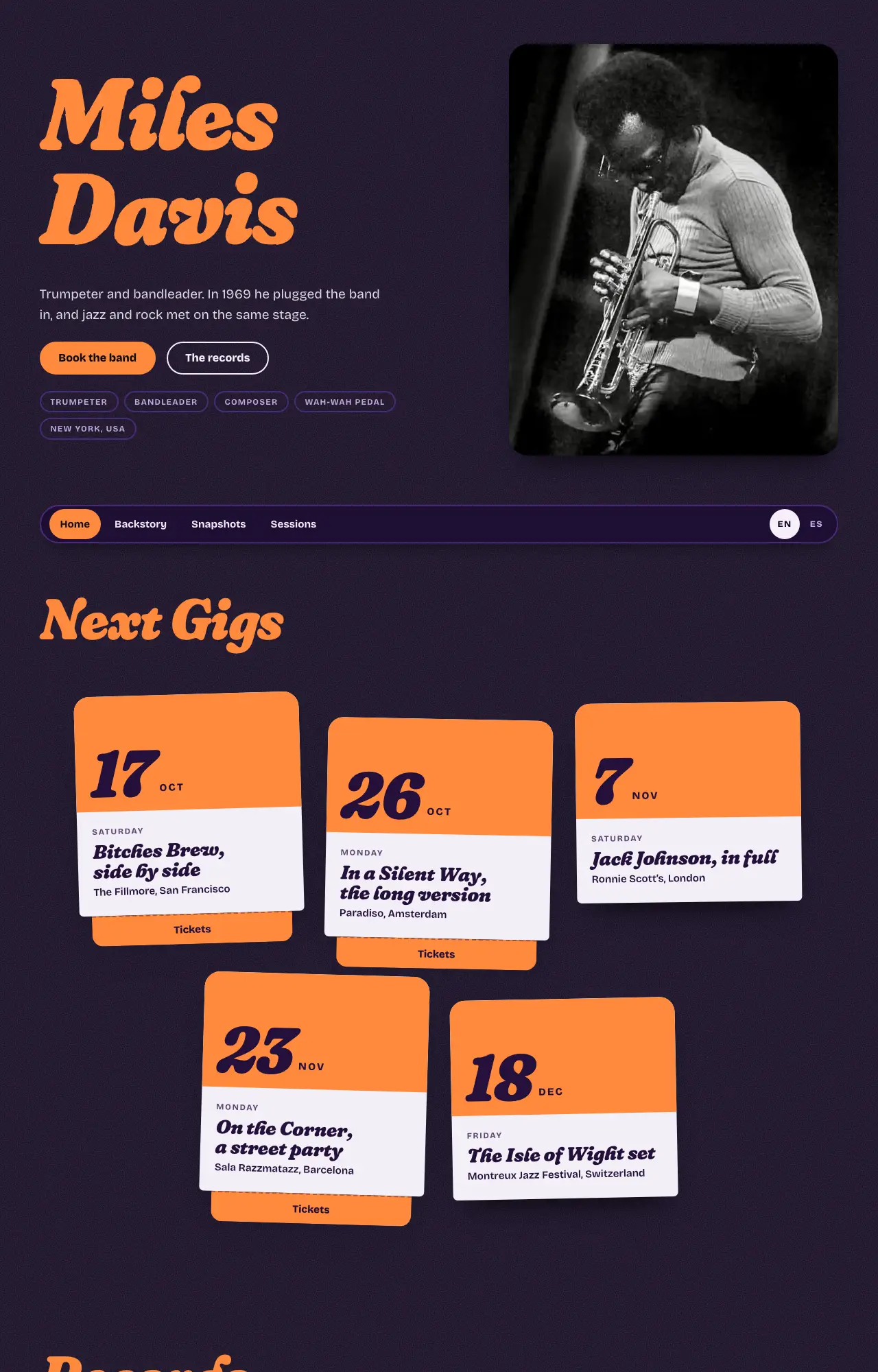
Miles. In 1969 Miles Davis plugged the band in, and jazz met rock. His theme is a club night in violet and black with one hot ink, and gig posters with a tear-off ticket.
Record sleeves
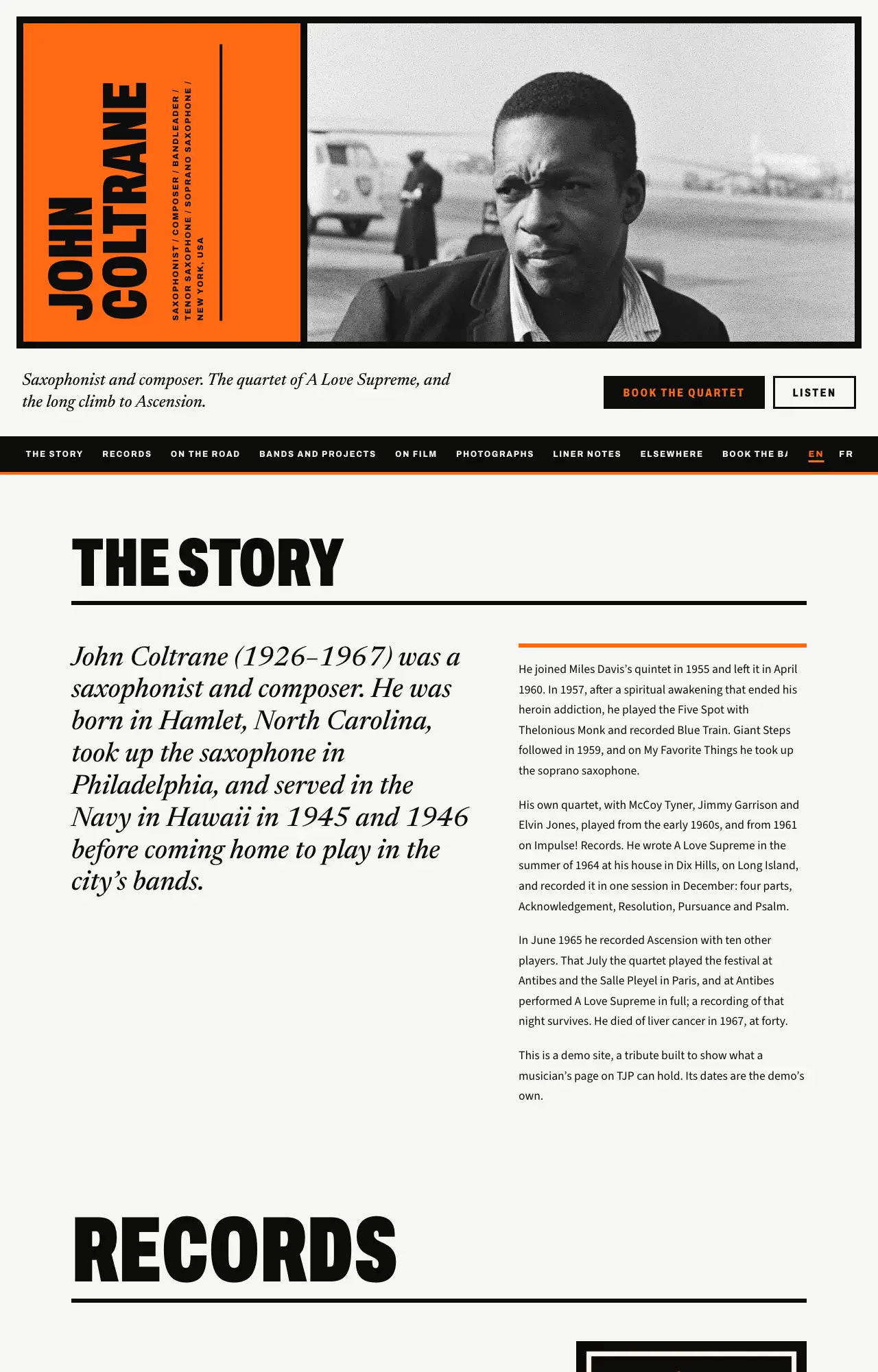
Coltrane. In December 1964 John Coltrane recorded A Love Supreme. His theme opens like the gatefold of a modern-jazz record: fields of colour, thick black frames and photographs under a grain.
Ella. Ella Fitzgerald began her Songbooks in 1956. Her theme borrows the loose ink line of fifties sleeves: white paper, a single pen line, flat colours and hand lettering that bounces.
Mingus. Charles Mingus recorded Mingus Ah Um in 1959, and his theme looks like that record: colours that collide and type that shouts.
Jobim. Antonio Carlos Jobim wrote the songs of bossa nova. His theme is full of sunlight: a white page, a photograph in front of one flat colour, thin capitals and hairlines.
Paper, ink and the bandstand
Gould. Glenn Gould recorded the Goldberg Variations in 1955. His theme is an engraved score: cream paper, black ink, staves and bar lines.
Monk. Thelonious Monk played the “wrong” notes on purpose. His theme is built on dissonance: a white page, one off-key colour and a grid that lands a beat late.
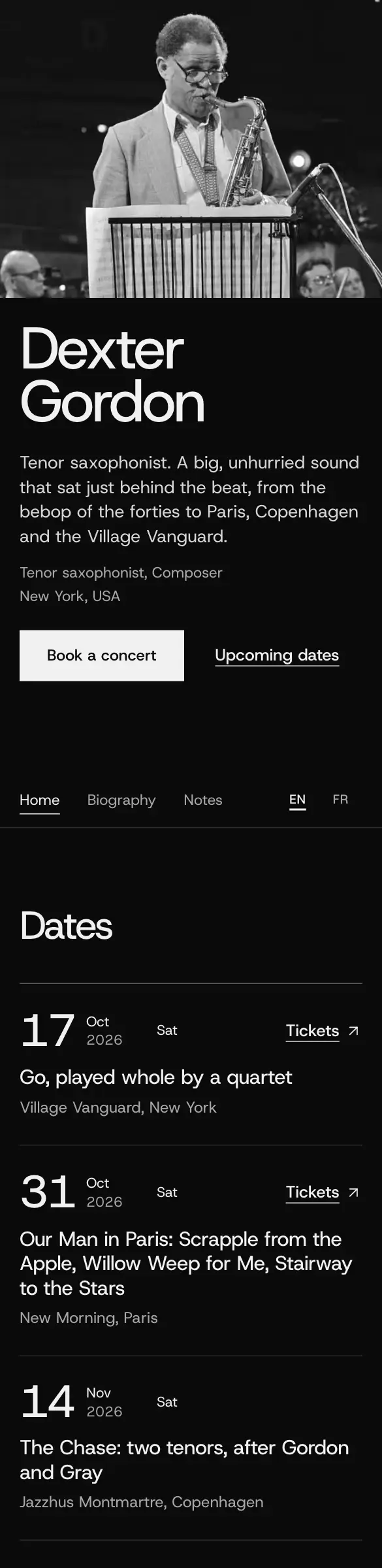
Dexter. Dexter Gordon, the great tenor saxophone, moved to Europe in 1962. His theme stays in black and white: every photograph in greyscale, one typeface and nothing else.
Cole. Nat King Cole, pianist and velvet voice. His theme is warm and clear: a white page, soft corners and one friendly colour.
Basie. Count Basie and his orchestra brought the swing of Kansas City. His theme shows the whole band large under its name. The dates sit on a steady board, and booking is always within reach.
Four styles, by day and by night
Every theme comes with four styles. A style pairs a colour with a typeface, and its name comes from the musician’s world. Coltrane’s are named after his records: A Love Supreme, Giant Steps, Ascension and Blue Train. Bolden’s are named after the halls and streets where jazz was born.
Each theme also has a day version and a night version. The night can use the same style as the day or a different one. You can also pick a colour of your own.
Every theme is on every plan, the free one included. Each has its own demo site, a full tribute to its musician, so you can see the theme at work before you decide.
How to choose yours
No theme is right for everyone. Yours is the one that says the same thing about you as your music. These questions help you find it:
- By the music. Think about the feel of your gigs more than the genre. Does your audience dance, listen in silence, sing along? A dance-hall poster and an engraved score tell very different stories.
- By the photos you have. Some themes rest on one strong photograph: Jobim sets it in front of a flat colour. If your photos come from different years and different light, Dexter evens them out in black and white. If you have a good shot of the whole band, Basie shows it large.
- By who books you. A jazz club, a festival, a chamber music series and a wedding agency each look for something different. Choose the theme the person who pays you would recognise.
- By how it reads. Open the demo on your phone, by day and by night, and read your dates. If they are hard to read, change the style or the theme.
In Studio you can preview any theme with your own words and photos before you keep it. If you pick a colour that is hard to read by day or by night, Studio tells you straight away. The theme only changes the look: your blocks, your dates and your photos stay the same in all of them.
If you are building your site from scratch, start with what a musician’s website needs. If the theme you like depends on a strong photo, read the press photos guide first.
Your site, without the website work. Ask for your invitation.
Pages is the site and the Studio for musicians by The Jazz Passport. The technical side is done; you bring the music.