Why the blocks on your site keep one order
Pages puts your site’s blocks in order for you: who you are first, your music next, contact last. Why we decided it, and what the research says.
 By Joan Subirats, founder of The Jazz Passport7 min read
In this article
Going through the first sites published with Pages, we did not find two with the same order. One opened with its links to social networks, right under the hero. Another left its biography for the seventh block, so a visitor went through six sections without knowing whose site they were on. A third had no releases or videos on its home page, and put a photo gallery before anything you could listen to.
As it was
- 01Hero
- 02Links
- 03Videos
- 04Press
- 05Shows
- 06Releases
- 07About
- 08Documents
- 09Contact
As Pages reads it
- 01Hero
- 02About
- 03Releases
- 04Shows
- 05Videos
- 06Press
- 07Documents
- 08Links
- 09Contact
Nobody got it wrong. Each musician ordered their site by their own judgement, and that was reasonable. There is no reason they should know how a visitor reads a page, or what people remember from a list, and they should not have to. Pages is there to handle this detail and hundreds like it, so your site works without you having to think about them.
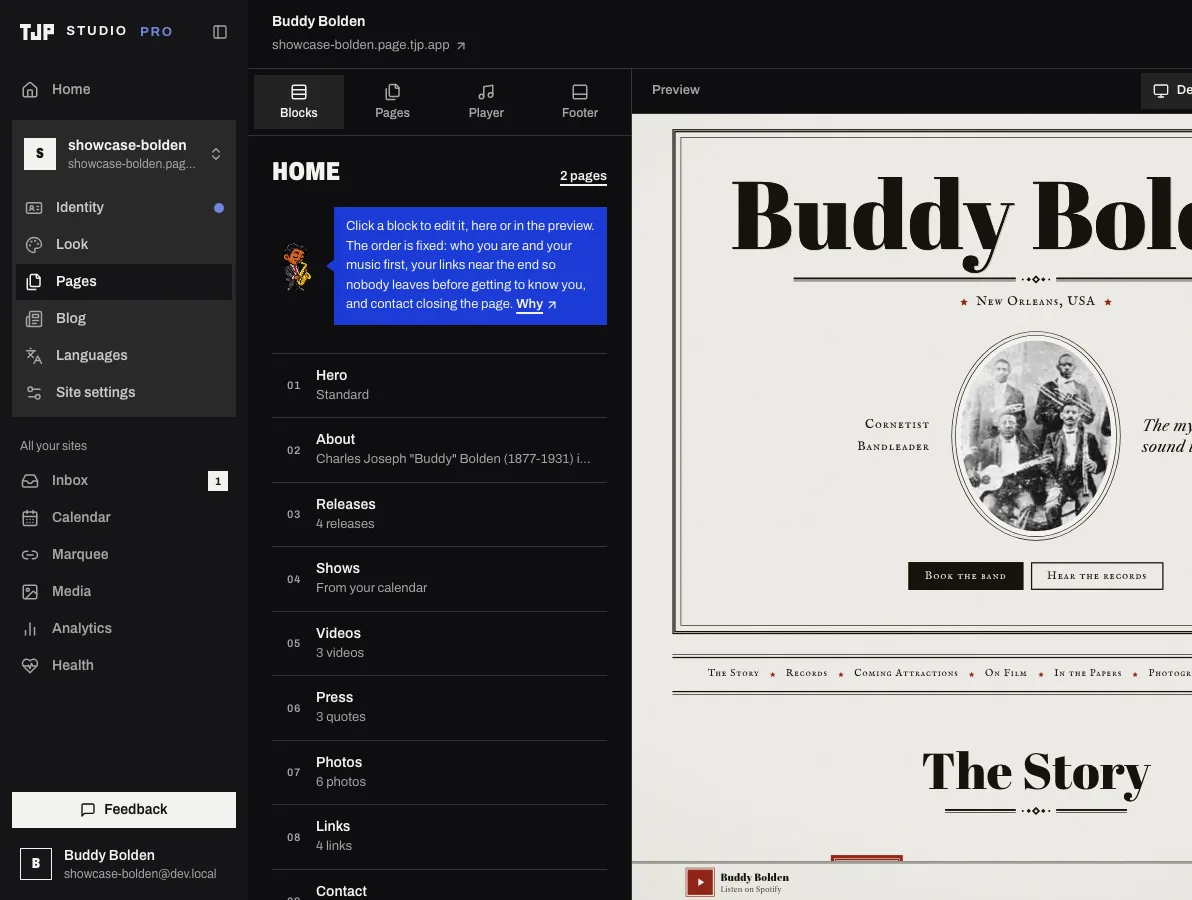
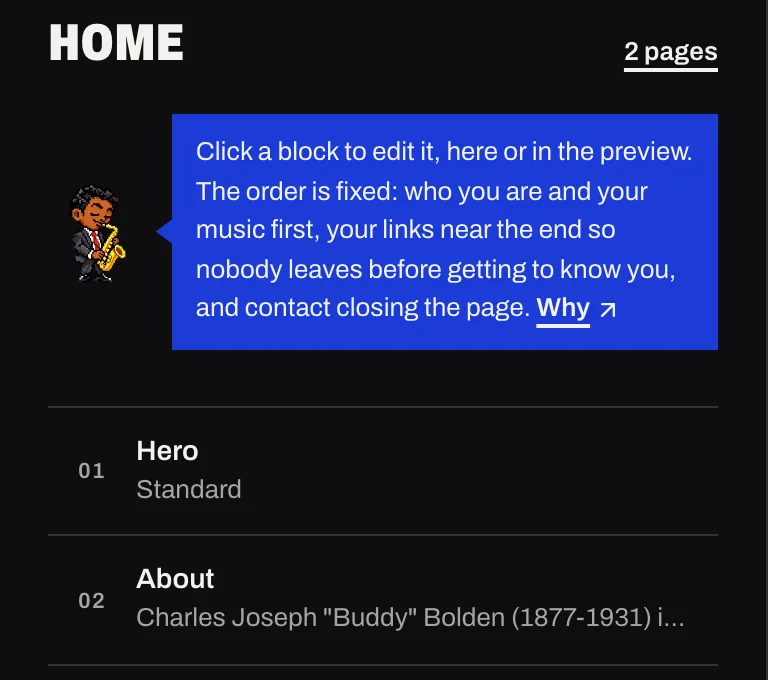
So in Pages you choose which blocks each page of your site shows, but not their order. Every block has its place: hero, about, releases, shows, videos, press, projects, photos, documents, links and, last, contact. Add a block and it goes to its place instead of to the end of the list. If your site had another order, it now reads in this one. This post explains why we decided it this way and what we based it on. It follows why your site's CTA leads to your contact and starts from the same idea.
What your site is for
As we said in the CTA post, the people who follow you already listen to you on the platforms and follow you on social media. The person who opens your site is more often someone who wants something from you: a venue, a festival, an agency, a journalist, a school looking for a teacher. Your site has a job your profiles cannot do for you: turning that visit into an offer.
You have ten seconds
That visit is decided quickly. Jakob Nielsen, of Nielsen Norman Group, looked at how long people stay on a page (How Long Do Users Stay on Web Pages?, 2011). Many visitors leave in the first 10 to 20 seconds, and the ones who get past about 30 seconds tend to stay. His advice: a page should say what it offers in under ten seconds.
The same firm used eye tracking to measure where attention goes (Scrolling and Attention, Therese Fessenden, 2018). People spend 57% of their time on what shows without scrolling, and 74% on the first two screenfuls. Whatever sits further down gets looked at less and less.
On a musician's site, the top of the page has to say who you are and how you sound. Put a list of links or a photo gallery there and you spend the most-viewed part of the page on what convinces the least.
People who book put it plainly. Courtney Gallagher, of Club Passim, a venue in Cambridge, Massachusetts, explained it on CD Baby's blog (Need to book or promote a gig?, Chris Robley, 2015). Say she is putting together a newsletter for 25,000 people and wants to feature a video of yours. If your site does not make that easy, she moves on to the next artist.
The first and the last are remembered
In 1962 Bennet Murdock measured how people recall a list (The serial position effect of free recall). They remember the first and last items best and forget the middle ones sooner. Psychology calls this the serial position effect.
A page is also a list, read while scrolling down. So Pages puts at the start what should stay with the visitor, who you are and how you sound. At the end goes what they need once they have decided, which is how to write to you. In between goes the material that helps them decide.
Contact, last and always at hand
Putting the form at the top looks like the direct option. In practice it asks for a decision before the visitor knows you. If contact is the third block, people scroll past it because they do not know yet who you are or what you do, and nobody writes to someone they do not know. A form in that spot leads no one anywhere and just takes up space.
Pages' order walks visitors toward your contact. First they meet you, then they hear you and see you live, then they read what others say about you and look over the rest of your work. By the time they reach the form, they have reasons to write to you.
They do not have to scroll to the end to do it. The contact button is the hero's first button, and the menu keeps it in sight on every page, phones included, as we explained in the CTA post. Whenever someone decides they have seen enough, the way to write to you is right there.
A link out is a way out
Your links to Spotify, Instagram or YouTube do what they promise: they take the visitor away from your site. They drop them on a platform built to keep them watching, which will suggest another musician's video when yours ends.
That is why the Links block sits near the end, just before contact. There it serves someone who has already heard you and wants to follow you. In second place, before they have heard a note, it is an exit in the hallway.
At the top
- Who you are
- Your music
- Your next shows
- Your live videos
Further down
- Your photos
- Your documents
- Your social media and platforms
- Your contact, which closes
Pages' order, block by block
- Hero. Who you are: your name, a photo, a line, and the button that leads to your contact.
- About. Two lines that place you: your style, your training, where you are from. The essentials first.
- Releases. How you sound. People who book decide by listening, not by reading.
- Shows. Your next dates, each with its tickets. They expire, and they give people a reason to come back.
- Videos. What you are like live, the proof someone hiring you asks for.
- Press. What others say about you. It convinces most right after the visitor has heard and seen you.
- Projects. The rest of your work: other bands, commissions, collaborations.
- Photos. Material for whoever writes about you or announces your show.
- Documents. The press kit, the rider or the tech sheet, for whoever has already decided.
- Links. Your social media and platforms, for whoever wants to follow you afterwards.
- Contact. It closes the page: the last thing a visitor sees is how to write to you.
Why it cannot be changed
We could have left it as a recommendation. Then you would need to know all of the above to have a site that works, and your job is the music. You decide what your site tells, and Pages puts it in order.
What is still yours:
- Which blocks each page shows. Take blocks off and the rest move up. If your home page has only the hero, about, projects and contact, your projects come third.
- Which page each thing goes on. If something does not belong on your home page, move it to another page of your site, such as an about or a press page.
- What each block is called. You can change every section's title in Studio.
When something else would make sense
Sometimes you will want something to come first. Almost every case fits in Pages without touching the order:
- You have just released a record. The hero's New release layout puts the sleeve and where to listen at the top.
- You have shows coming up. The hero's second button can lead straight to your dates.
- Your work is your projects. Keep only the essentials on your home page and your projects will move up on their own.
How it works in Pages
- When you add a block, it goes to its place on the page instead of to the end. Contact still closes it.
- If your site had another order, it already reads in this one. Nothing is lost: the content, the titles and the blocks you took off stay where they were.
- Every page follows the same order, private ones too.
- In Studio, you can no longer drag the blocks in each page's list, and Dex reminds you why.
To see what else people who book look at in those first seconds, read on with what a booker looks for on your site.
Your site, without the website work. Ask for your invitation.
Pages is the site and the Studio for musicians by The Jazz Passport. The technical side is done; you bring the music.