Introducing Pages: a site and a Studio made only for musicians
Why we made Pages, who it is for and what it already does: the site, the Studio, the dates, the bookings and the technical side done.
 By Joan Subirats, founder of The Jazz Passport5 min read
In this article
A musician who wants to get booked needs something to send before anything else: a link. A promoter, a venue or a journalist opens it, and within seconds they should know who you are, what you sound like, when you play next and how to book you. Pages is that link. It is also where you run everything behind it.
Why we made Pages
General website builders can make almost anything, which is why they know nothing about music. To them a date, a record or a press kit is just more text and images. They give you a blank page and a long list of options, and the rest is up to you. You pick fonts. You look up what a sitemap is. You try to work out whether you need a cookie banner, and why Google doesn't show your gigs.
Social media has a different problem. It reaches the people who already follow you, but it does little to get you booked by people who don't know you yet. A promoter is not going to scroll through your Instagram looking for the rider.
Pages is made only for musicians. Its blocks already know what a concert is, and a record, a tour and a press page. Around the site there is a Studio for everything else: your dates, your booking requests, your visits.
What Pages is
Your site. One page or several, built from blocks: home, biography, records, dates, videos, photos, press, contact. You pick a theme, adjust it to your taste and publish. Every change stays a draft until you choose to publish it, so you can try things out without worrying.
Your Studio. This is where you edit the site and watch a live preview change as you go. You add your dates to the Calendar and read requests in the Inbox. You can see how many visits you get and where they come from, and check your site's Health.
Your card. You write who you are once: your name or your band's, a photo, what you play and where you are based. Every site you make shows that card. Your roles, your instruments and your town each have their own eye to hide them, and anything you hide never reaches the page or the search engines.
The technical side, done
A working site needs a lot that nobody sees. Google has to understand who you are and read your dates as concerts. The site has to load quickly on a phone with poor signal. Visitors shouldn't be asked about cookies. A screen reader has to be able to get through it. Each language needs its own address.
In Pages all of that is already done. There is nothing to set up, and you can't break it by touching the wrong setting.
The technical side also changes every year, so we keep up with that too. Studio checks your published site and tells you, in your language, what is missing and where to fix it.
Getting booked, without losing messages
Every site has a booking form made for the people who book. It asks what they're looking for, the date, the place and their message. It is protected from spam. Each request lands in your Studio Inbox and in your email, and when you reply, your answer goes straight to the person who wrote.
What every Pages site already has
- Your dates on the site and in search results
- A booking form that lands in your Inbox
- Your music: Spotify, Apple Music, Bandcamp, SoundCloud or your own tracks
- Private pages for the press kit or the rider, by link or with a password
- Statistics without cookies and without a banner
- Your whole account, downloadable as one file whenever you like
Themes with a history
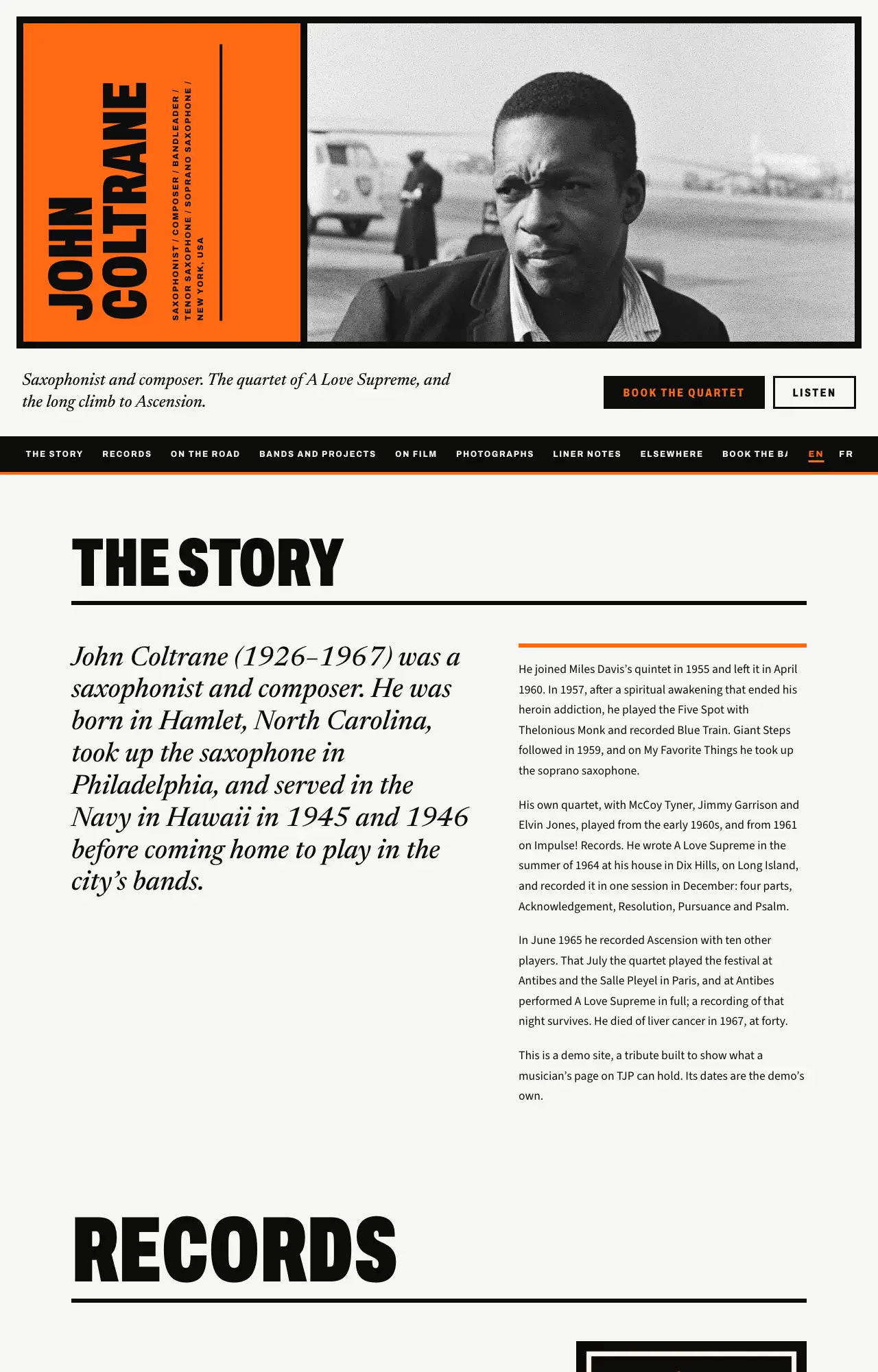
Each Pages theme takes its look from a jazz great: Buddy Bolden’s playbill, Ellington’s Art Deco gold, the gatefold of a Coltrane record, Dexter Gordon’s black and white. Every theme has a day style and a night style, and all of them come with every plan. There is more about them in the themes guide.
And Dex
When you open Studio, Dex is there to welcome you. He is a little saxophonist who shows you where everything is, tells you what is missing and cheers when you fix it. He has his own post.
What is coming
We are building two more things. The School will let you sell courses from your own site. And a Newsletter of your own will let you write to the people who listen to you. Each one will arrive when it's ready.
How to get in
Pages is in private beta. We let musicians in a few at a time, by hand, so we can listen to each one. If you want to try it, ask for your invitation and we will write to you when there is room.
Your site, without the website work. Ask for your invitation.
Pages is the site and the Studio for musicians by The Jazz Passport. The technical side is done; you bring the music.