What you need to sell lessons and courses from your own site
If you teach, your site can be your school too. What to prepare before you record the first lesson, and how to shape a course.
 By Joan Subirats, founder of The Jazz Passport7 min read
In this article
If you teach, you already have the hard part: you know how to explain music. Taking it online changes everything around that explanation. Before you choose a camera or a platform, decide what you will teach, who it is for and in what order. This guide covers what to have ready before you record the first lesson, so the course holds up when someone who has never met you opens it.
First, who it is for and where it leads
Think of a course as a road. The student sets off from one place and arrives at another. A folder of videos has neither. Before you think about content, write down two things: what your student can already do when they start, and what they will be able to do when they finish.
"Learn jazz" gives you nothing to aim at. "Improvise over an F blues with the basic scales and arpeggios" does. The more concrete the end point, the easier it is to decide what goes in and what stays out.
Pin down the level and the instrument too. A harmony course for intermediate pianists is easier to teach than "harmony for everyone", and whoever is looking for it can tell at a glance whether it is for them.
How to build the syllabus
- Write one sentence that says what the student will be able to do at the end.
- List what they need to get there: concepts, technique, repertoire, ear.
- Group that list into modules, from the simplest to the most demanding.
- Give each lesson a single goal and one exercise that checks it.
- Record a test lesson and give it to a real student before you record the rest.
Most people skip the last step, and it saves the most time. In ten minutes, a real student will show you where you go too fast, what you take for granted and which exercise nobody understands.
How long a lesson should be
An hour in the room flies by because there is conversation. In front of a video, the same hour drags. A working rule: one idea per lesson, and the lesson lasts as long as that idea and its exercise take. Often that is a few minutes.
Short lessons also get watched again. Someone practising goes back to the video over and over to see one particular move, and finds it faster when it is not buried at minute forty.
If a topic needs more time, split it into several lessons, each with a clear title. "Seventh chords: the theory" and "Seventh chords: the exercise" are easier to find your way around than one long video.
Picture and sound
In a music lesson, sound comes before picture. A student will forgive a camera that is a little dark. They will not forgive an instrument that sounds distant, distorted or full of echo.
- A microphone close to the instrument, and another for your voice if you talk while you play. A laptop microphone picks up the room more than the instrument.
- A quiet room without echo. Curtains, a rug or a full bookshelf make a big difference in an empty room.
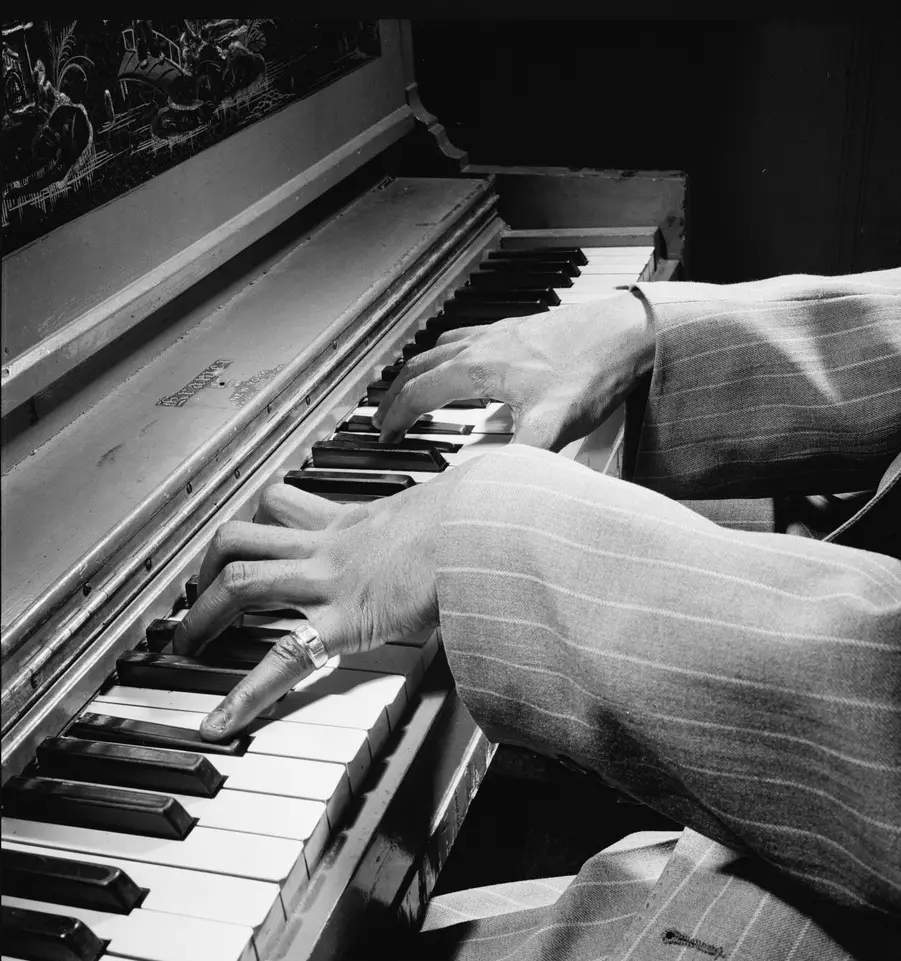
- A shot of the hands. On piano, guitar or double bass, the student needs to see where the fingers go. A second fixed camera over the keyboard or the neck is worth more than a better main camera.
- Light from the front or the side, never from behind you.
- Landscape video, and a short test before every session: record ten seconds and listen back on headphones.
The materials
A music course lives as much on what the student takes away as on what they watch. Prepare the materials before you record, because the video will refer to them.
- Scores and tabs as PDFs that read well on screen and on paper, each named after its lesson.
- Play-along tracks: the backing without your instrument, at several tempos, from a slow practice tempo up to the real one.
- Transcriptions of the solos or phrases you analyse.
- An exercise sheet for each module, with what the student should be able to play before moving on.
What you give away and what you charge for
The free part lets someone decide whether they want to learn with you. Give them a complete lesson they can use. A trailer tells them very little. A real lesson shows how you explain, how you sound and how the rest of the course is organised.
What works for free
- A whole lesson from the start of the course
- The full syllabus, so the road is visible
- One play-along track with its score
- The title and a few seconds of every paid lesson
What does not
- An introduction video with no content
- Lessons cut off halfway
- A price hidden until the last step
- Giving the whole course away and charging only for the scores
You set the price. Compare it with what you charge for a live lesson and with what other teachers of your instrument and level ask. State it plainly from the start, along with what it includes.
How the student follows their progress
In the room you can see the student. Online you cannot, so the course has to show them where they are.
- Each lesson can be marked as done, and the student sees how much is left.
- Each module ends with an exercise that can be checked: play a tune at a given tempo, record a chorus of improvisation, transcribe a phrase.
- Ask them to record themselves. Listening back is the best correction there is, and if they send it to you, you have something to talk about.
- Decide whether lessons open all at once or in order. Opening them in order stops students from skipping steps they will need later, but it frustrates someone who already knows the basics.
Live, recorded or both
Live lessons over video call come closest to your usual lesson: you correct on the spot and adjust the pace. But every lesson takes an hour of your time, latency makes real playing together impossible, and schedules get complicated when students live in other countries.
A recorded course takes a lot of work once. After that, anyone can follow it at any hour. In exchange, nobody corrects the student unless you arrange it.
Many teachers combine the two: the recorded course carries the content, and a live session now and then handles questions and corrections, or a one-to-one lesson for whoever wants it.
Before you open the course
- One sentence that says what the student will be able to do at the end
- The full syllabus, by modules and lessons
- A test lesson checked by a real student
- Clean sound and a shot of the hands
- Scores, tracks and exercises named after their lesson
- The rights to every tune you use, checked
- One complete free lesson
- A clear price, with what it includes
From your own site
When you sell from your own site, whoever comes for your lessons also finds your records, your dates and your story. They get to know you as a musician as well as a teacher. That is why the site should be complete before the course opens. We go through what it needs in what a musician's website needs.
At Pages we are building the School, so you can sell courses from your own site. It is not open yet. It will come when it is ready.
Your site, without the website work. Ask for your invitation.
Pages is the site and the Studio for musicians by The Jazz Passport. The technical side is done; you bring the music.