Demo · Ella Fitzgerald
Examples
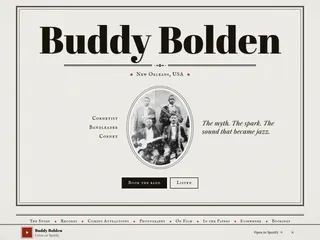
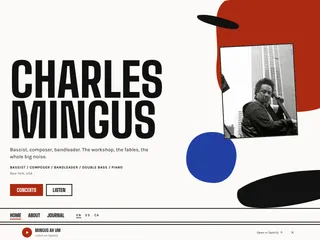
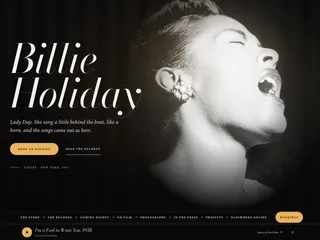
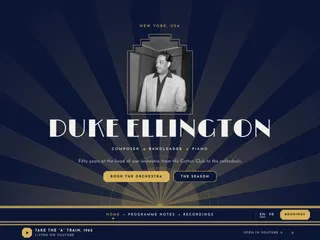
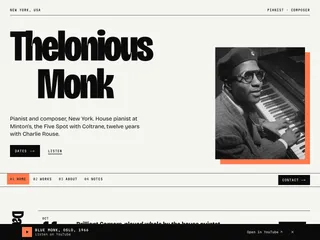
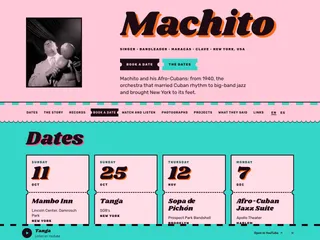
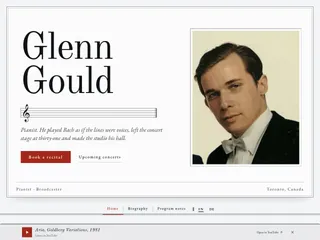
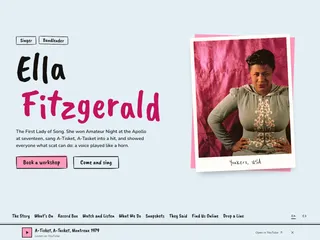
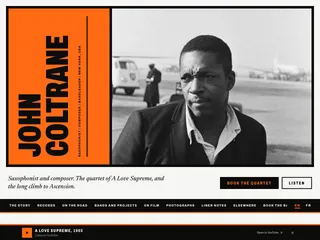
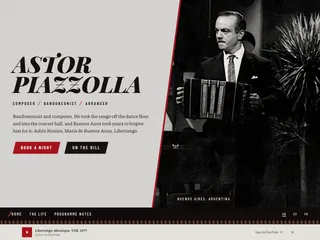
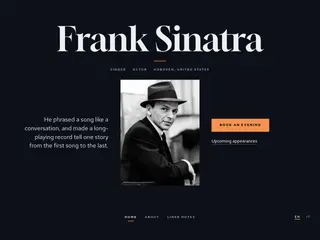
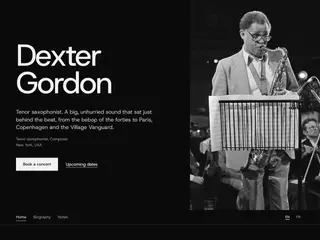
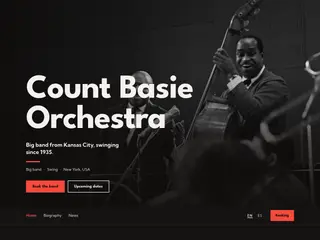
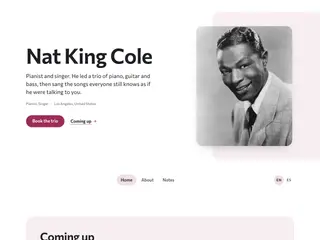
Each theme has a site dedicated to the musician it is named after.


Pages
What a visitor can open on this site.
Theme
The world the site is drawn in. The content stays the same.
Day or night
The ground under everything: it changes the site the most.
Style
A colour and a typography made for each other.
Colour
In place of the style's accent, in every theme. Deeper by day, softer by night.
The theme's own
Hero
How the page opens.


Yonkers, USA
Singer · Bandleader
Ella Fitzgerald
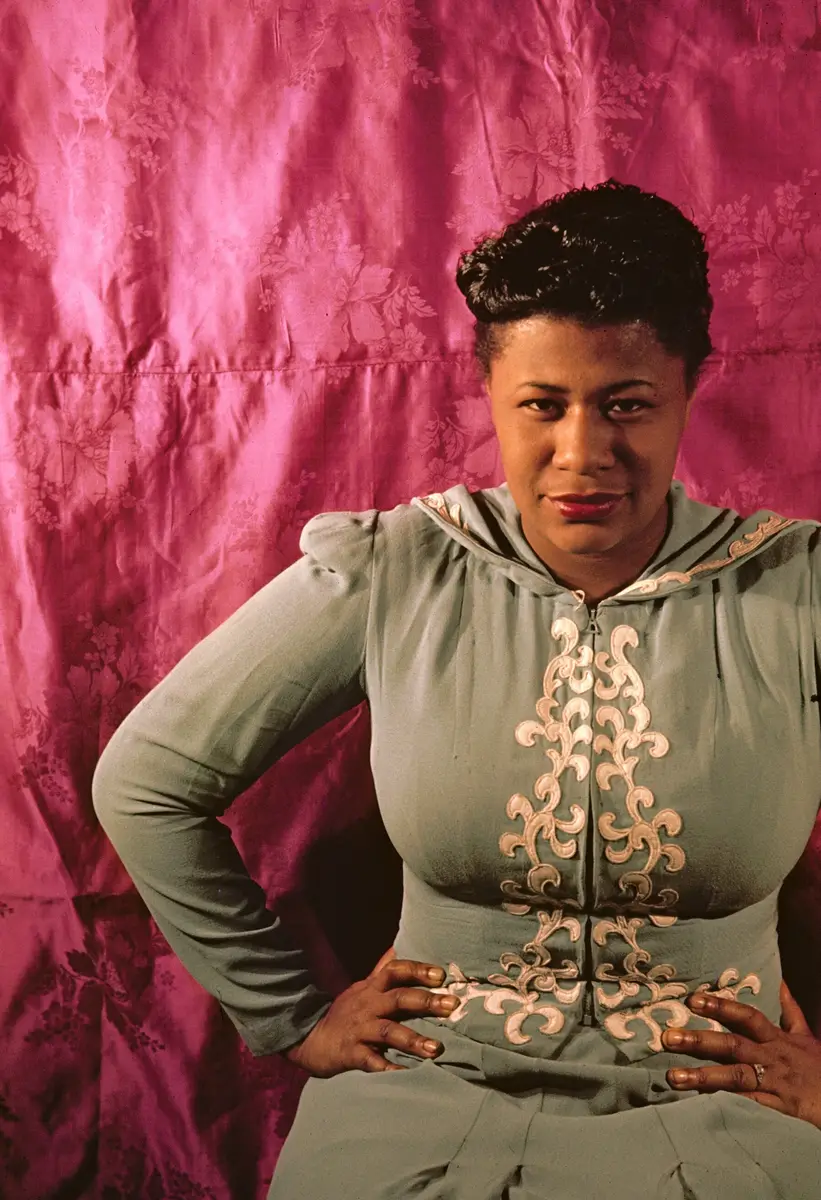
The First Lady of Song. She won Amateur Night at the Apollo at seventeen, sang A-Tisket, A-Tasket into a hit, and showed everyone what scat can do: a voice played like a horn.
About
Ella Fitzgerald (1917-1996) was born in Newport News, Virginia, and grew up in Yonkers, New York. She loved to dance, and to sing along with the records of Louis Armstrong, Bing Crosby and the Boswell Sisters; she said she tried so hard to sound just like Connee Boswell. After her mother died in 1932 she went to live with an aunt in Harlem.
On 21 November 1934, at seventeen, she went on stage at the Apollo Theater’s Amateur Night, meaning to dance, and sang instead. She won. In 1935 the drummer and bandleader Chick Webb took her into his orchestra, and at the Savoy Ballroom in Harlem she sang for the dancers. In 1938 her own version of a children’s rhyme, A-Tisket, A-Tasket, made her and the band famous.
When Webb died in 1939 she led the orchestra for three years. In the 1940s, singing with Dizzy Gillespie’s band and on the tours of the producer Norman Granz, she made scat singing her own: she sang what she heard the horns play, and made up the words as she went.
In the mid-1950s Granz started Verve Records around her, and she began the Song Books, an album for each great American songwriter, Cole Porter first, then Rodgers and Hart, Duke Ellington, Irving Berlin and the Gershwins. In Berlin in 1960 she forgot the words to Mack the Knife and made up new ones on the spot; the record won her two Grammys. She won thirteen in all, and in 1993 set up a foundation for music education and for children in need. She died in Beverly Hills on 15 June 1996.
This is a demo site, a tribute built to show a TJP site for a singer who teaches: workshops, family shows and a private pack for schools. Its dates are the demo’s own.
Records
Ella in Berlin: Mack the Knife, 1960
Ella Fitzgerald Sings the Cole Porter Song Book, 1956
Ella and Louis, 1956
Ella Fitzgerald Sings the Duke Ellington Song Book, 1957
Ella Fitzgerald Sings the George and Ira Gershwin Song Book, 1959
Ella and Basie!, 1963
A-Tisket, A-Tasket, 1938
Ella Fitzgerald Sings the Rodgers and Hart Song Book, 1956
Dates
Scat class: copy a trumpet
Jazz Museum in Harlem, New York
Amateur Night, a family show
Apollo Theater, New York
A-Tisket, A-Tasket, a children’s concert
Hudson River Museum, Yonkers
The Cole Porter Song Book night
Jamboree Jazz Club, Barcelona
Choir day: Mack the Knife, with the wrong words
Conservatori del Liceu, Barcelona
Film
Press
Where other singers, most notably Louis Armstrong, had tried similar improvisation, no one before Miss Fitzgerald employed the technique with such dazzling inventiveness.
I just tried to do [with my voice] what I heard the horns in the band doing.
My mother brought home one of her records, and I fell in love with it... I tried so hard to sound just like her.
I had gotten to the point where I was only singing be-bop. [...] Norman felt that I should do other things, so he produced the Cole Porter Song Book with me. It was a turning point in my life.
Here was a black woman popularizing urban songs often written by immigrant Jews to a national audience of predominantly white Christians.
Works
Chick Webb and the Savoy
In 1935 the drummer Chick Webb took a gawky teenager into his orchestra. At the Savoy Ballroom in Harlem she sang for the dancers, and in 1938 her version of a nursery rhyme, A-Tisket, A-Tasket, made the band famous. She led it herself after he died in 1939.
en.wikipedia.orgThe Song Books
Eight albums, from 1956 to 1964, each given to one great American songwriter: Cole Porter first, then Rodgers and Hart, Duke Ellington, Irving Berlin, the Gershwins, Harold Arlen, Jerome Kern and Johnny Mercer.
en.wikipedia.orgVerve and Jazz at the Philharmonic
The producer Norman Granz took her on tour with his Jazz at the Philharmonic concerts, became her manager, and started Verve Records around her in the mid-1950s. Photo: William P. Gottlieb, Library of Congress, public domain.
en.wikipedia.org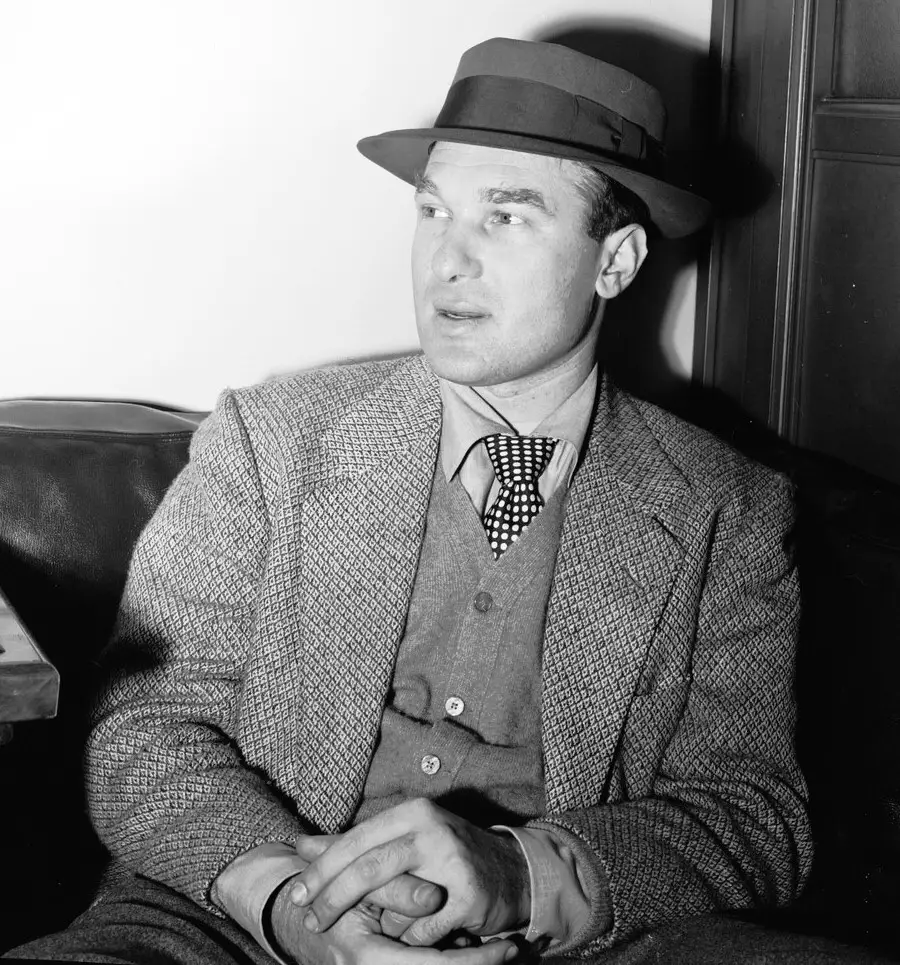
Berlin, 1960
At the Deutschlandhalle she forgot the words to Mack the Knife, made up new ones on the spot, and the record won her two Grammys. A good story for any class that is afraid of getting it wrong.
en.wikipedia.orgScat: a singing class
Scat is singing without words, the voice played like a horn. Her 1945 Flying Home is where many start; she said she just tried to do what she heard the horns in the band doing. Our workshops begin by copying a trumpet.
en.wikipedia.org
Photographs
In Carl Van Vechten’s studio, 19 January 1940. Carl Van Vechten, public domain
At the Downbeat club, New York, about September 1947, with Dizzy Gillespie, Ray Brown, Milt Jackson and Timme Rosenkrantz. William P. Gottlieb, Library of Congress, public domain
On the stairs, New York, about November 1946. William P. Gottlieb, Library of Congress, public domain
At Schiphol airport, Amsterdam, 5 May 1957. Harry Pot, Nationaal Archief / Anefo, CC0
The same studio session, 19 January 1940. Carl Van Vechten, public domain
Arriving at Schiphol with a bouquet, 24 April 1964. Anefo, Nationaal Archief, CC0
A night performance in the Netherlands, 19 February 1961. Hugo van Gelderen, Nationaal Archief / Anefo, CC0
Elsewhere
Contact
Book a workshop, a concert or a class
Schools, choirs, libraries and families. Tell us the day, the room and how many will be singing; we answer within two days.