
Octeto Buenos Aires
Formed in 1955, after Paris: two bandoneons, two violins, cello, double bass and an electric guitar among them. It lasted until 1958.
Read more (Octeto Buenos Aires)Each theme has a site dedicated to the musician it is named after.
What a visitor can open on this site.
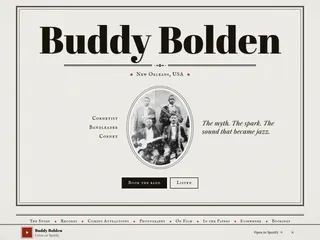
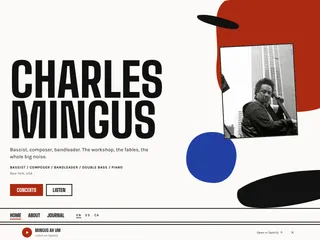
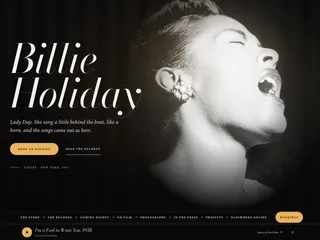
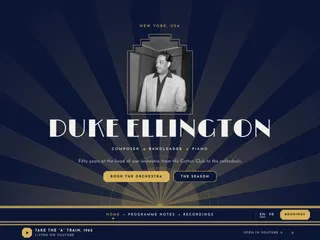
The world the site is drawn in. The content stays the same.
The ground under everything: it changes the site the most.
A colour and a typography made for each other.
In place of the style's accent, in every theme. Deeper by day, softer by night.
The theme's own
How the page opens.
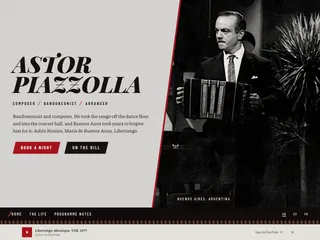
Astor Piazzolla (1921-1992) was born in Mar del Plata. In 1925 his family moved to New York, to Greenwich Village, and in 1929 his father, Vicente "Nonino" Piazzolla, bought him a bandoneon from a pawn shop. At thirteen he met Carlos Gardel in New York and played a newspaper boy in Gardel’s film El día que me quieras; Gardel invited him on tour, his father said no, and the tour ended in the plane crash of 1935.
Back in Buenos Aires he joined Aníbal Troilo’s orchestra in 1939 as a bandoneonist and arranger, and studied composition with Alberto Ginastera. In 1953 his Buenos Aires Symphony won the Fabien Sevitzky prize, and with it a French government grant to study in Paris. There, in 1954, he played Nadia Boulanger one of his tangos, Triunfal, and she told him that this, and not the symphony, was the music he should go on writing.
He made the tango a chamber music. The Octeto Buenos Aires (1955) put an electric guitar in a tango band; the Quinteto of 1960 (bandoneon, violin, piano, electric guitar and double bass) became his model. He wrote Adiós Nonino in New York in October 1959, after his father’s death, in less than an hour. In 1968 he and the poet Horacio Ferrer made María de Buenos Aires, a tango operita premiered with the singer Amelita Baltar, and in Milan in May 1974 he recorded Libertango.
Purists in Buenos Aires called it a betrayal. After a heart attack in 1973 he kept working: the second Quinteto, the Quinteto Tango Nuevo, from 1978; Le Grand Tango, written in 1982 for Mstislav Rostropovich; Tango: Zero Hour in 1986; The New Tango with Gary Burton in 1987. He had a bypass operation in 1988, suffered a cerebral haemorrhage in Paris on 4 August 1990, and died in Buenos Aires on 4 July 1992.
This is a demo site, a tribute built to show a TJP Web site: pages, a menu, a journal and three languages. Its dates are the demo’s own.
Formed in 1955, after Paris: two bandoneons, two violins, cello, double bass and an electric guitar among them. It lasted until 1958.
Read more (Octeto Buenos Aires)From 1960 to 1970: bandoneon, violin, piano, electric guitar and double bass. The model for everything he wrote for a small group afterwards.
Read more (The first Quinteto)A nonet founded in the early 1970s, for the larger scores. It was dissolved within the year for want of money, and he brought it back in 1983.
Read more (Conjunto 9)The second Quinteto, formed in 1978, which toured the world for eleven years and recorded Tango: Zero Hour.
Read more (Quinteto Tango Nuevo)The vibraphonist and the bandoneonist on The New Tango, issued on Atlantic in 1987: a vibraphone among the bandoneon’s bellows.
Read more (With Gary Burton)