

A box from a pawn shop
In 1929 Vicente Piazzolla, who had settled his family in New York, saw a bandoneon in a pawn shop and bought it for his son. Astor was eight. He told the story himself, and it is always the same: the box arrived wrapped, he was sure it held the roller skates he had asked for so many times, and it was a letdown.
The instrument
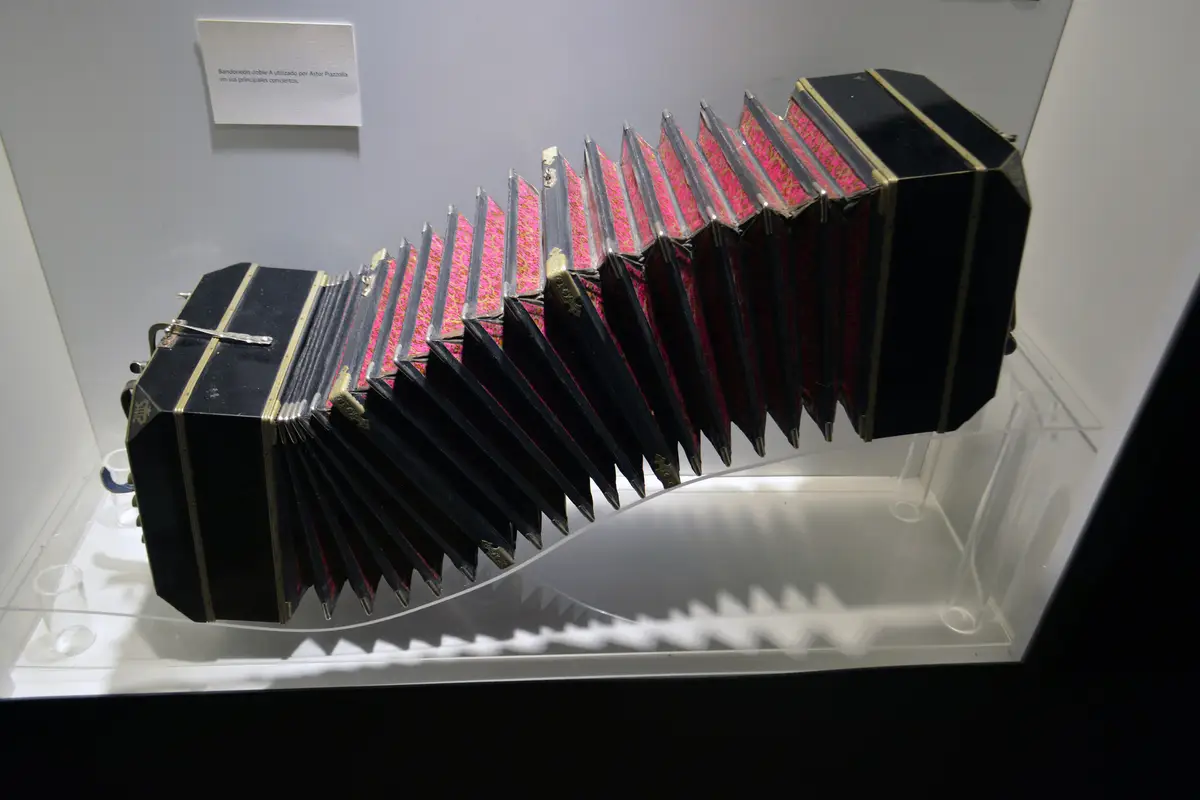
A bandoneon is a free-reed instrument, a cousin of the accordion, built in Germany in the nineteenth century for church music and taken to the River Plate by sailors and emigrants. It has no keyboard in the piano’s sense: each button sounds a different note when the bellows open and when they close, so the player must know, by hand, which way the air is going.
Why it suits the tango
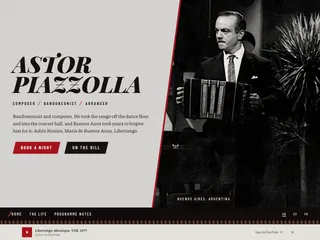
The bellows are the lungs of the tango. The instrument has to be breathed, and it cannot be played without being seen to breathe, which is why he played standing, a foot up on a stool, the box open across his knee, and why the bellows are what the eye goes to.
The photograph above: a bandoneon that belonged to Piazzolla, at the Centro Cultural Néstor Kirchner, Buenos Aires, by ProtoplasmaKid (CC BY-SA 4.0).