Demo · Antonio Carlos Jobim
Examples
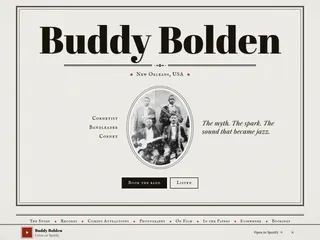
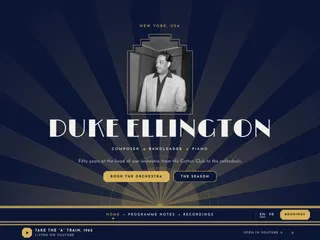
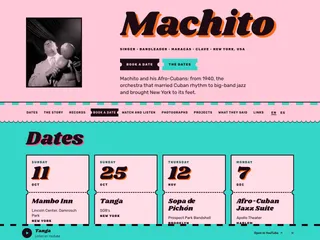
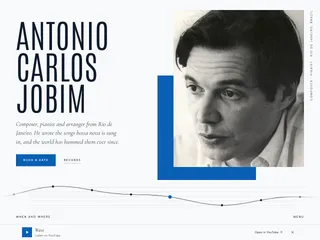
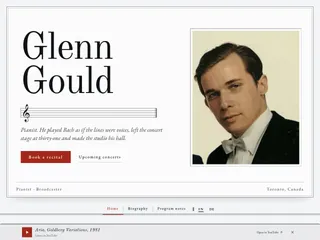
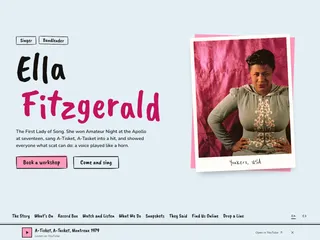
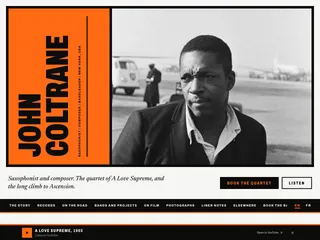
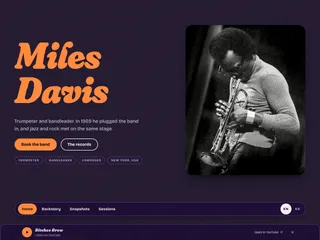
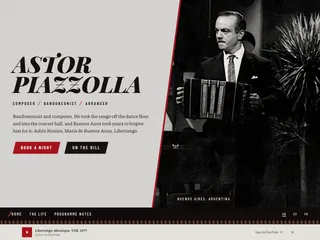
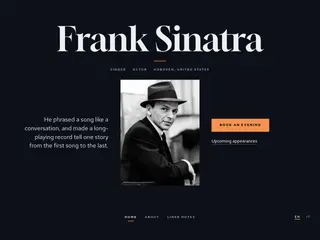
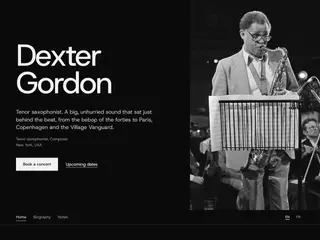
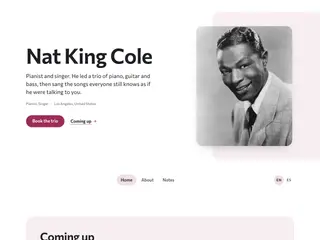
Each theme has a site dedicated to the musician it is named after.




Pages
What a visitor can open on this site.
Theme
The world the site is drawn in. The content stays the same.
Day or night
The ground under everything: it changes the site the most.
Style
A colour and a typography made for each other.
Colour
In place of the style's accent, in every theme. Deeper by day, softer by night.
The theme's own
Hero
How the page opens.

Composer · Pianist · GuitarRio de Janeiro, Brazil
Biography
Antonio Carlos Jobim (1927–1994), Tom to everyone, was a composer, pianist and arranger, born in Tijuca and brought up in Ipanema, in Rio de Janeiro.
He studied piano as a boy, with Hans-Joachim Koellreutter among his teachers, and listened to Pixinguinha, Debussy and Ravel. In the 1950s he played in the bars and nightclubs of Copacabana and worked as an arranger for the record labels. In 1956 he began to write with the poet Vinicius de Moraes, for the play Orfeu da Conceição, whose film version, Orfeu Negro, came out in 1959.
In 1958 João Gilberto recorded Chega de Saudade with the guitar beat that gave the new music its shape, and the record of the same name followed in 1959, with Desafinado among its songs. Jobim played at Carnegie Hall in 1962. Garota de Ipanema, written with Vinicius that year, reached the world on Getz/Gilberto, recorded in New York in March 1963 and released in 1964, which won the Grammy for Album of the Year in 1965.
Wave came out in 1967, with Claus Ogerman’s strings, the same year as his record with Frank Sinatra; then Stone Flower in 1970 and Águas de Março in 1972. In 1968 his Sabiá, with words by Chico Buarque, won the Festival Internacional da Canção in Rio. Elis & Tom, with Elis Regina, was recorded in Los Angeles in 1974. From the 1980s he played with the Banda Nova, and in 1987 he made Passarim.
He died in New York on 8 December 1994, aged 67, three days before his last record, Antonio Brasileiro, came out. Rio’s international airport carries his name.
This is a demo site, a tribute built to show what a musician’s page on TJP can hold. Its nights are the demo’s own.
Recordings
Concerts
- Tickets
Garota de Ipanema, Rua Vinicius de Moraes, Rio de Janeiro
Garota de Ipanema, voice and guitar
Monday 19 OCT 2026
- Tickets
Sala Cecília Meireles, Rio de Janeiro
Águas de Março
Wednesday 28 OCT 2026
Blue Note Rio, Copacabana
Wave, with strings
Monday 9 NOV 2026
- Tickets
Theatro Municipal, São Paulo
Chega de Saudade
Monday 23 NOV 2026
Blue Note, New York
Corcovado, at the piano
Friday 18 DEC 2026
Videos
Reviews
My music comes from this environment here, you know, the rain, the sun, the trees, the birds, the fish.
Stan, João is saying that his dream always was to record with you.
Essential for all serious jazz collections.
Elis is an incredible singer.
Projects
Vinicius de Moraes
The poet and the composer met in 1956, for the play Orfeu da Conceição, and went on to write Chega de Saudade, Garota de Ipanema and a long run of songs. For Orfeu Negro they wrote three songs over the telephone while they were apart.
en.wikipedia.org(opens in a new tab)Getz and Gilberto
Stan Getz, João Gilberto and Jobim at the piano, in New York on 18 and 19 March 1963. Astrud Gilberto sang the English verses of Garota de Ipanema; the record won the Grammy for Album of the Year.
en.wikipedia.org(opens in a new tab)Sabiá, with Chico Buarque
The song with words by Chico Buarque that won the Festival Internacional da Canção in Rio in 1968. The two were photographed together at the festival that October.
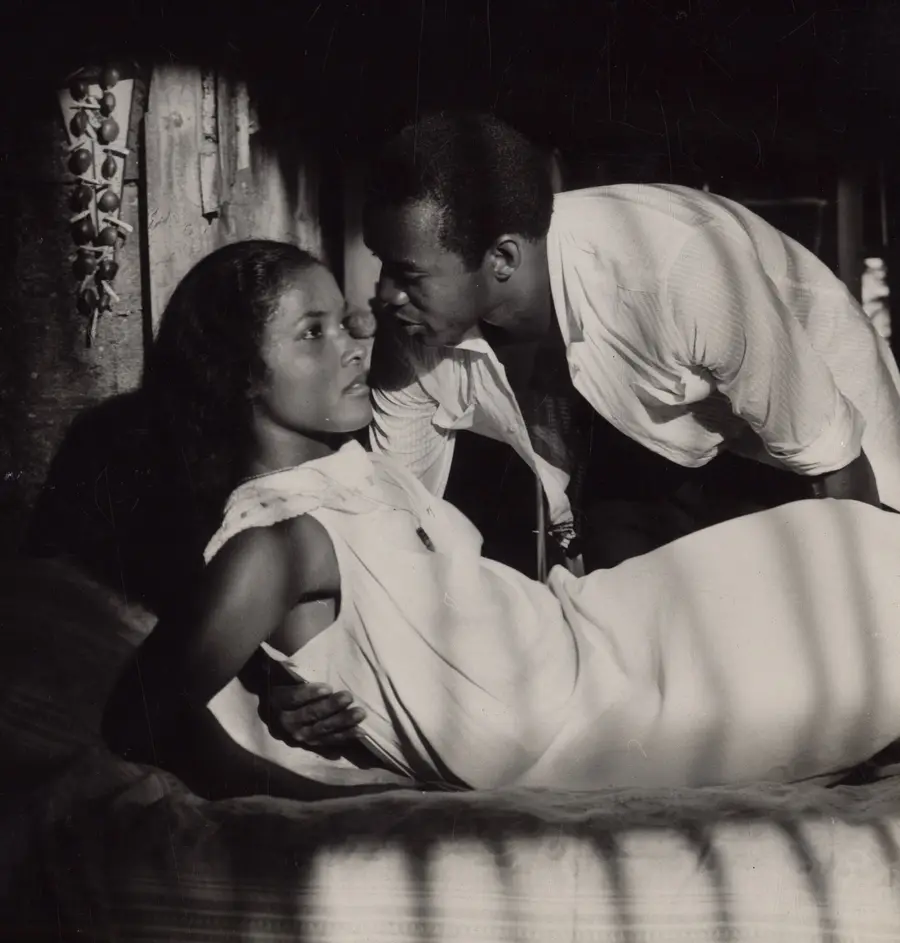
en.wikipedia.org(opens in a new tab)Orfeu Negro
Marcel Camus’s film of 1959, from the play Jobim and Vinicius wrote three years before. The score is by Luiz Bonfá and Jobim, and A Felicidade, by Jobim and Vinicius, opens it.
en.wikipedia.org(opens in a new tab)


Photographs
Scores and documents
Links
Booking
Book a night of songs
Bars, restaurants, weddings, radio, a duet you have in mind: voice and guitar, piano and strings, or the whole band. Tell us the date and the room, and we will answer within the week.